메시지를 남겨주세요
Howo 트럭에 관심이 있으시고 더 자세한 정보를 원하시면 여기에 메시지를 남겨주세요. 8시간 이내에 답변드리겠습니다.

A vacuum pump is one of the most important components of a vacuum truck. It creates negative pressure inside the tank, allowing wastewater, sludge, and other liquid waste to be drawn into the tank through the suction hose. In the vacuum truck industry, three well-known Italian vacuum pump brands are Battioni Pagani, Jurop, and Moro. These manufacturers offer a wide range of vacuum pump models with different airflow capacities, vacuum levels, and cooling systems to meet various operational requirements.
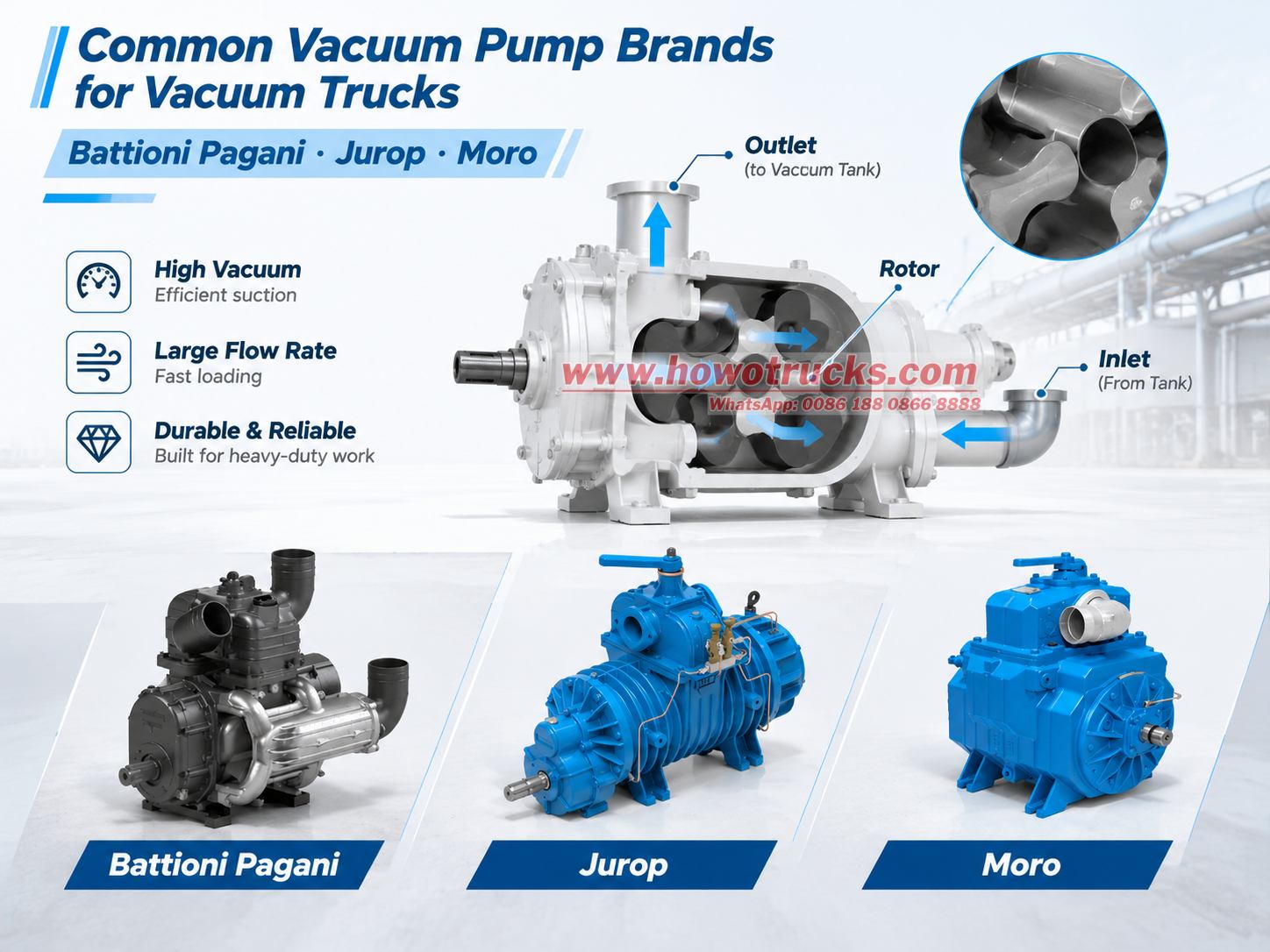
This article introduces the functions of vacuum pumps in vacuum trucks, compares these three major brands, and explains how to choose the right vacuum pump for your application.
» SEC.01 What Is the Function of a Vacuum Pump in a Vacuum Truck?
How Does a Vacuum Pump Work?
A vacuum pump works by extracting air from the vacuum tank, reducing the air pressure inside it and creating a pressure difference between the inside and outside of the tank.
The working process can be divided into four steps:
1. Power Transmission: The truck engine drives the vacuum pump through a power take-off (PTO), gearbox, or hydraulic drive system.
2. Air Extraction: The vacuum pump removes air from the tank, gradually reducing the internal pressure.
3. Waste Suction: Atmospheric pressure pushes wastewater, sludge, and other liquid waste through the suction hose and into the vacuum tank.
4. Pressure Release: Once the tank reaches the required filling level, the suction process is stopped. For systems equipped with positive-pressure functionality, the vacuum pump can switch to pressure mode to assist with waste discharge.
» SEC.2 Three Common Vacuum Pump Brands
1. Battioni Pagani Vacuum Pumps
Battioni Pagani specializes in vacuum pumps and systems for industrial and agricultural applications. Its products are widely used in vacuum trucks, wastewater cleaning equipment, and other tanker applications.
The company offers several types of vacuum pump technologies, including rotary vane pumps, Roots vacuum pumps, and liquid ring vacuum pumps.
Common Product Series:
· KPS Series: Rotary vane vacuum/pressure pumps featuring liquid cooling and air-injection cooling technologies. They can be used for continuous suction and positive-pressure discharge.
· BLW Series: Roots-type vacuum pumps featuring two synchronized three-lobe rotors. The pump chamber operates without oil or water, making them suitable for industrial applications requiring high air-handling capacity.
· BLR Series: Liquid ring vacuum pumps designed for handling liquids, sludge, and contaminated fluids, making them suitable for demanding operating environments.
Key Features:
· Offers multiple pump technologies for different applications.
· Covers both standard and heavy-duty vacuum systems.
· Provides different configurations to match airflow capacity and operating requirements.
· Selected models support both continuous vacuum and pressure operation.
2. Jurop Vacuum Pumps
Jurop manufactures vacuum pumps, compressors, and fluid-handling equipment. Its products are widely used in vacuum trucks, sewer cleaning vehicles, and industrial waste collection systems.
Jurop offers a variety of vacuum equipment, mainly including sliding-vane vacuum pumps and Roots blowers.
Common Product Series:
· PN / PNR Series: Air-cooled sliding-vane vacuum pumps designed for tanker applications and intermittent operating cycles.
· RV / RVC Series: Fan-cooled sliding-vane pumps designed for both vacuum and pressure applications.
· LC / PR Series: Water-cooled sliding-vane pumps suitable for heavy-duty vacuum equipment and vehicle-mounted systems.
· DL / PVT Series: Roots blowers equipped with air-injection cooling. These oil-free units are designed for high-volume air handling.
Key Features:
· Offers a wide range of airflow capacities.
· Provides air-cooled, fan-cooled, water-cooled, and air-injection cooling configurations.
· Uses both sliding-vane and Roots blower technologies.
· Suitable for standard vacuum trucks as well as heavy-duty industrial suction equipment.
3. Moro Vacuum Pumps
Moro focuses primarily on rotary vane vacuum pump technology. Its products are commonly used in septic tank cleaning trucks, industrial vacuum tankers, and waste collection vehicles.
Moro offers various pump configurations to meet different airflow requirements and cooling needs.
Common Models:
· PM60A: An air-cooled rotary vane vacuum pump designed for standard vacuum suction operations.
· PM70A: An air-cooled model offering a higher airflow capacity than the PM60A.
· PM80A: A larger air-cooled model suitable for applications requiring greater airflow capacity.
· PM70T / PM80T: Fan-cooled pump models designed to improve heat dissipation and meet specific operating requirements.
· PM60W / PM80W: Water-cooled models suitable for applications requiring additional cooling capacity.
Key Features:
· Uses rotary vane vacuum pump technology.
· Offers different models with varying airflow capacities.
· Provides air-cooled, fan-cooled, and water-cooled configurations.
· Supports different drive options to meet vehicle installation requirements.
» SEC.03 Comparison of Battioni Pagani, Jurop, and Moro
The following table provides a quick comparison of the three vacuum pump brands.
ComparisonBattioni PaganiJuropMoro
Main TechnologiesRotary vane, Roots, liquid ringSliding vane, RootsRotary vane
Common Series / ModelsKPS, BLW, BLRPN, RV, LC, DLPM60A, PM70A, PM80A
Cooling MethodsVaries by seriesAir-cooled, fan-cooled, water-cooled, air-injectionAir-cooled, fan-cooled, water-cooled
Typical ApplicationsVacuum tankers, industrial suctionVacuum trucks, sewer cleaningSeptic tank cleaning trucks, vacuum trucks
Each brand has its own product characteristics. The right choice depends on the required airflow capacity, operating conditions, cooling requirements, and vehicle configuration.
» SEC.04 How to Choose the Right Vacuum Pump for Your Vacuum Truck
Selecting the right vacuum pump is essential for ensuring efficient operation, reliable performance, and long service life. Here are three important factors to consider.
1. Match the Airflow Capacity to the Tank Size and Application
The required airflow capacity depends on the tank volume, suction depth, and intended application.
The following ranges can be used as general selection references:
· Small Septic Tank / Service Trucks: 1,000–8,000 L/min. Suitable options may include Battioni MEC, Jurop PN Series, and Moro PM60/PM70.
· Medium-Sized Municipal Tankers: 8,000–20,000 L/min. Potential options include Battioni Ballast, Jurop LC/PN, and Moro PM80/PM90.
· Large Industrial Vacuum Trucks: 20,000+ L/min. Potential options include Battioni KPS/FAN, Jurop LC580/NVE, and Moro PM110.
The actual pump selection should always be based on the manufacturer's specifications and the vehicle's operating requirements.
2. Consider the Cooling Method
Cooling performance directly affects the operating temperature and service life of a vacuum pump.
· Air-Cooled or Dual-Fan-Cooled Pumps: Models such as Moro PM90T and certain Jurop air-cooled series are generally easier to install and do not rely on the truck's cooling system.
· Water-Cooled Pumps: Models such as the Jurop LC Series and Moro X3W are suitable for heavy-duty applications where additional cooling capacity is required.
When selecting a cooling system, consider the expected operating duration, ambient temperature, installation space, and maintenance requirements.
3. Check Compatibility and Cross-Reference Specifications
When replacing an existing vacuum pump, several technical specifications must be checked to ensure proper compatibility:
· Mounting dimensions and installation position.
· Rotation direction.
· Lubrication requirements.
· Inlet and outlet connection diameters.
· Cooling system configuration.
· Drive system compatibility.
Battioni Pagani provides a cross-reference chart for corresponding Moro models, which can help users identify potential replacement options.
However, model equivalence should always be verified against the manufacturer's technical specifications before purchasing or installing a replacement pump.
» SEC.05 Frequently Asked Questions (FAQ)
Q1: What type of vacuum pump is most commonly used in vacuum trucks?
Rotary vane vacuum pumps are commonly used in standard vacuum trucks. They can generate the vacuum required for waste suction, and some configurations also support positive-pressure discharge.
For applications requiring higher airflow capacities, Roots blowers can also be considered.
Q2: What is the difference between a rotary vane vacuum pump and a Roots blower?
A rotary vane vacuum pump uses sliding vanes mounted on a rotor to create chambers of varying volume. This allows the pump to draw in and compress air.
A Roots blower, on the other hand, uses two synchronized rotating lobes to move air through the pump.
The two technologies differ in their operating principles, airflow characteristics, and cooling requirements. Rotary vane pumps are commonly used in conventional vacuum trucks, while Roots blowers are suitable for applications requiring high-volume air handling.
Q3: Can a vacuum pump be used for both suction and discharge?
Yes. Many vacuum trucks use vacuum/pressure pumps that support both functions.
A four-way valve is typically used to switch between vacuum mode for suction and positive-pressure mode for discharge. However, the actual functionality depends on the specific pump model and the vehicle's piping configuration.
Q4: What is the difference between air-cooled and water-cooled vacuum pumps?
Air-cooled vacuum pumps use natural airflow or cooling fans to dissipate heat, while water-cooled pumps use circulating water to control operating temperatures.
Air-cooled pumps generally have simpler installation requirements and do not need a dedicated water-cooling circuit. Water-cooled pumps are more suitable for applications requiring greater cooling capacity and sustained heavy-duty operation.
Q5: Can a vacuum pump directly handle wastewater containing solid particles?
A vacuum pump is primarily designed to move air rather than directly pump wastewater or solid waste.
A properly designed vacuum truck system should include overflow protection, air-liquid separation devices, and filtration components to prevent wastewater and solid particles from entering the vacuum pump.
These protective components help prevent pump damage and improve system reliability.
Q5: How often should a vacuum pump be serviced?
The maintenance interval depends on the pump model, operating hours, and working environment.
Operators should regularly check oil levels, lubrication conditions, cooling performance, filters, seals, and wearing parts.
Oil replacement and component inspections should follow the maintenance schedule specified by the manufacturer.
» SEC.06 Conclusion
Battioni Pagani, Jurop, and Moro are three well-known Italian vacuum pump brands in the vacuum truck industry. Each manufacturer offers different models and configurations to meet a wide range of suction and waste-handling requirements. When choosing a vacuum pump for your vacuum truck, it is important to consider tank capacity, actual operating requirements, airflow performance, cooling methods, and vehicle compatibility.
메시지를 남겨주세요
스캔해서 위챗/왓츠앱으로 전송하세요 :



 한국어
 English
 Français
 Deutsch
 Русский
 Italiano
 Español
 Português
 Nederland
 日语
 Türk
 Ελληνικά
 แบบไทย
 Magyar
 Indonesia
 Tiếng Việt
 عربي
 Қазақстан
 မြန်မာ
 Filipino
 kiswahili
 Türkmenler
 o'zbek
 Кыргызча
 українська
 čeština
 Slovák
 Română
 فارسی
 hrvatski
 Svenska
 中文



 IPv6 네트워크 지원